
Outdoor Activity as Exercise: Parks, Trails, and Free Recreation Near You
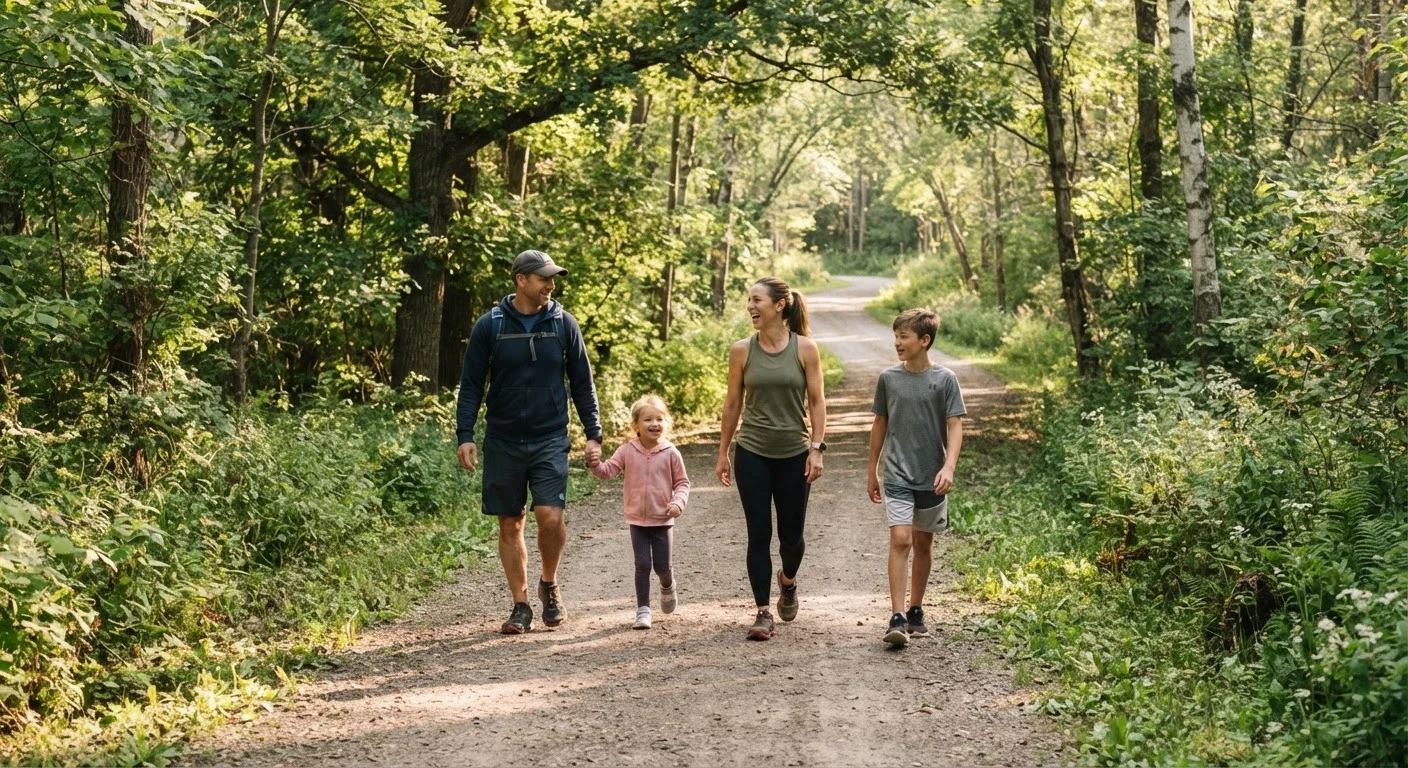
Photo credit: seeksmartgrowth.com
In this article
Learn how parks, trails, and community recreation spaces can replace costly fitness classes while keeping the whole family moving.
Key Takeaways
- Public parks, trails, and recreation centers provide structured exercise opportunities at no cost.
- Outdoor activity meets general physical activity guidelines for adults and children alike.
- Consistency on a familiar local route is more sustainable than expensive, sporadic gym sessions.
- Many communities offer free or low-cost programs through parks and recreation departments.
- Outdoor movement builds habits the whole family can maintain across seasons and budget changes.
Why outdoor recreation works as a fitness strategy
Gym memberships and fitness apps carry real costs, and for families watching their budgets, those costs add up fast. Public outdoor spaces, by contrast, are tax-funded infrastructure that most households already have access to. The question is how to use them deliberately enough that they function as a genuine exercise plan rather than an occasional stroll.
Outdoor activity covers the full range of fitness components: cardiovascular endurance from sustained walking or cycling, muscular strength from trails and playground installations, and flexibility from warm-up routines done on grass or a park bench. None of that requires spending money. What it does require is consistency, which is harder to build than most people expect. The real cost of inactivity is worth understanding before deciding whether free outdoor exercise is "enough."
A note on physical activity guidelines
The U.S. Department of Health and Human Services recommends that adults get at least 150 minutes of moderate-intensity aerobic activity per week and that children get 60 minutes of physical activity daily. These are general public health guidelines, not personal prescriptions. Anyone with a health condition, injury, or concern about starting an exercise routine should consult a qualified healthcare professional before making changes.
The seven approaches below are practical starting points for families at different fitness levels and in different types of communities. Use them selectively based on what is actually available within reasonable distance of your home.
Seven ways to make outdoor spaces work for your family
Start with what your local parks department already offers
Most municipal parks and recreation departments run free or very low-cost programs year-round: walking clubs, guided nature hikes, outdoor yoga sessions, and youth sports leagues. These programs are publicly funded and designed for general community use, so they do not require any membership to access.
Search your city or county parks website for a seasonal program guide. Many departments also post schedules at park entrances or community bulletin boards. Starting here costs nothing and reveals structured activity options that most families do not know exist.
Publicly funded parks programs are designed for community use and require no membership.
Use trails as a built-in cardio and strength circuit
A trail is not just a walking path. Inclines build leg strength. Uneven terrain activates stabilizing muscles that flat treadmill surfaces do not reach. A moderate hike on a hilly trail can match the cardiovascular demand of a gym elliptical session for many adults, without any equipment cost.
Trail-finder tools from the National Park Service and state forestry agencies list difficulty ratings, elevation gain, and surface conditions at no charge. Start with shorter, well-maintained trails and progress over several weeks. This gradual approach reduces injury risk and keeps the activity sustainable for mixed-age groups.
Uneven trail terrain activates stabilizing muscles that flat gym equipment does not reach.
Turn playground equipment into a bodyweight workout
Public playground equipment supports a range of bodyweight movements for adults and older children: pull-up bars, parallel bars, and inclined surfaces appear in many city parks as part of fitness trails or outdoor gym installations. Movements such as assisted pull-ups, incline push-ups, and bench step-ups require no additional gear.
While younger children use play structures for unstructured activity (which itself contributes to their recommended daily movement), adults can work alongside them. This arrangement removes the childcare barrier that often prevents parents from exercising separately. For ideas on complementary low-equipment routines, see our guide to bodyweight training vs. home equipment.
Outdoor fitness installations let parents exercise alongside children, removing the childcare barrier.
Incorporate active commuting and errand routes
Walking or cycling to nearby destinations accumulates meaningful physical activity without scheduling a separate workout. Researchers at the Centers for Disease Control and Prevention note that moderate-intensity activity such as brisk walking counts toward the 150 minutes per week recommended for adults, regardless of whether it occurs in a single block or across many short trips.
A round trip to a school, library, or grocery store can cover one to three miles depending on the neighborhood. Over a week, these trips add up to a substantial portion of recommended activity targets. Families who live in walkable areas can treat errands as exercise infrastructure rather than lost time.
Brisk walking to errands counts toward weekly activity targets just as a gym session does.
Join or organize a neighborhood walking group
Social accountability is one of the most reliable predictors of exercise adherence. A walking group with neighbors or coworkers costs nothing to start and adds consistency to an otherwise irregular schedule. Even two or three people meeting twice a week on a fixed route creates enough structure to build a lasting habit.
Community apps, neighborhood association boards, and local library bulletin boards are practical ways to find existing groups or recruit members. This approach also works well with the broader framework described in our guide to building a weekly wellness routine on a tight schedule. For families still choosing between activity formats, why consistency beats intensity explains why regular moderate movement tends to produce better outcomes over time.
Social accountability through a walking group is one of the most reliable drivers of exercise adherence.
Check community centers for free access periods
Many YMCA branches, community recreation centers, and school district facilities offer free or reduced-fee access during specific hours or for families below certain income thresholds. Financial assistance programs for these facilities are often underused because they are not prominently advertised.
Call the facility directly and ask about scholarship programs, sliding-scale fees, or open community hours. Some school districts open gymnasium and track facilities to the public outside school hours at no charge. This provides a weather-independent option when outdoor conditions make trail or park use impractical.
Scholarship and sliding-scale programs at community centers are often underused because they are not prominently advertised.
Build seasonal variety to prevent routine fatigue
Outdoor recreation changes with the seasons, and that variety is an asset. Swimming in public pools or natural bodies of water in summer, leaf-pile raking and apple orchard visits in fall, snowshoeing or sledding in winter, and cycling or kite flying in spring all count as physical activity. Changing the activity keeps motivation intact across months.
Seasonal rotation also distributes physical demands across different muscle groups, which reduces the repetitive-strain risk that comes with doing the same workout year-round. Pair each season's outdoor activity with a consistent warm-up practice: our family morning stretching guide takes under ten minutes and works for all ages.
Seasonal activity rotation distributes physical demands and keeps motivation intact across months.
Making the habit stick
The biggest obstacle for most families is not finding a park or trail. It is returning to the same place consistently after the initial novelty fades. Treating outdoor exercise the same way you would a scheduled appointment, assigning a regular time slot and a default route, is more effective than leaving it open-ended.
Start with a frequency and duration that fits your current schedule without requiring major sacrifice. A 20-minute walk three times a week is a more durable starting point than an ambitious daily two-hour hike. Over several weeks, small increases in time or distance build capacity without burnout. If you want a fuller framework for fitting movement into a busy week, see our weekly wellness routine guide.
This article is for general informational purposes only and does not constitute medical advice. Consult a qualified healthcare professional before starting a new exercise routine, particularly if you have any existing health conditions or concerns.

Author
Health & Fitness Editorial Team
Health & Fitness Editorial Team is the collective byline for our editorial team and contributor network. Articles published under this byline or an editorial pen name are researched, written, and reviewed according to our editorial standards for clarity, consistency, and independence before publication.
View all articles →