
Dealership Service Center vs. Independent Mechanic: Weighing Your Options
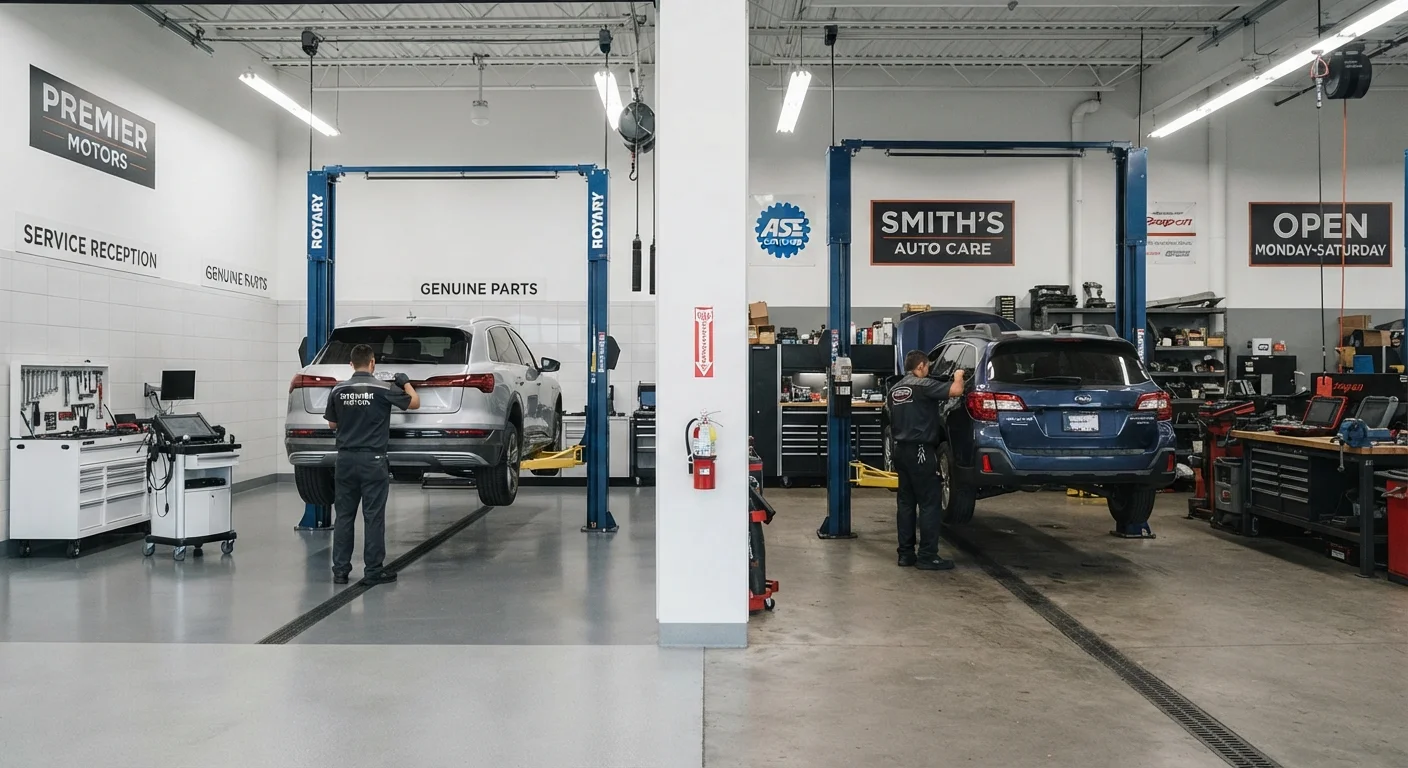
Photo credit: seeksmartgrowth.com
In this article
Both have real advantages depending on your situation. Compare cost structures, warranty considerations, and what each shop does best.
Key Takeaways
- Dealership service centers charge higher labor rates but have brand-specific training and OEM parts on hand.
- Independent mechanics typically offer lower hourly rates and can be a strong choice for out-of-warranty vehicles.
- Warranty status is one of the most important factors when deciding where to take your car.
- Either shop type can perform quality work; certification and verifiable reviews matter more than the sign on the door.
- Getting a written estimate before approving any work protects you regardless of which shop you use.
How the two shop types differ
Dealership service centers are owned by, or contracted to, a specific brand. Technicians there complete manufacturer training programs, and the shop stocks original equipment manufacturer (OEM) parts built to that brand's exact specifications. Independent mechanics, by contrast, work on multiple makes and often hold certifications from the National Institute for Automotive Service Excellence (ASE), a third-party credentialing body.
The practical difference in day-to-day service comes down to specialization versus flexibility. A dealership technician may spend every shift on a single model family. An experienced independent mechanic may have worked on dozens of makes over many years. Both paths produce skilled technicians; the depth runs in different directions.
| Dealership service center | Independent mechanic | |
|---|---|---|
| Typical labor rate | Higher (brand-market dependent) | Generally lower |
| Parts used | OEM standard | Aftermarket or OEM, buyer choice |
| Brand-specific training | Manufacturer-certified technicians | ASE or general experience |
| Proprietary diagnostic tools | Full manufacturer access | Professional tools, varying coverage |
| Warranty repair eligibility | Required for most warranty work | Allowed for routine maintenance (Magnuson-Moss) |
| Recall repairs | Required location | Not authorized |
| Pricing flexibility | Limited, some coupons available | More negotiable, competitive market |
Cost structure at each shop
Labor rates at dealerships typically run higher than at independent shops, often by $30 to $60 per hour depending on the market and brand. OEM parts also carry a price premium over aftermarket alternatives, which most independent shops use by default. For a straightforward job such as a brake pad replacement, the total bill at a dealership can be noticeably higher for identical work.
Independent shops have more pricing flexibility. They can source aftermarket parts, which meet or exceed OEM standards in many cases, and they face more competitive pressure to keep labor rates reasonable. However, very low quotes deserve scrutiny. Before approving any estimate, read through each line item so you understand what parts and labor hours are included.
Some dealerships offer service coupons, loyalty pricing, or complimentary multi-point inspections that partially close the cost gap. Factor those in before assuming the independent shop will always be less expensive for a specific job.
Warranty considerations
Federal law under the Magnuson-Moss Warranty Act generally prohibits manufacturers from voiding a warranty solely because an owner used an independent mechanic for routine maintenance, provided that maintenance meets the manufacturer's specifications. In practice, disputes can still arise, particularly around non-routine repairs. Having the independent shop document the work with receipts, the parts used, and the specifications met is important if a warranty claim comes up later.
Where the warranty picture is clearer is with active recall repairs and most extended manufacturer warranties: those typically must be performed by an authorized dealership to qualify for coverage. If your car has an open recall, the dealership is the correct destination regardless of your usual preference.
For vehicles past the manufacturer warranty, this consideration disappears, and the cost calculus shifts more cleanly toward whichever shop offers the better value for the specific repair needed. Deferring that repair, wherever you take it, compounds costs over time. Small deferred repairs often grow into larger bills faster than most owners expect.
Diagnostic capability and specialized repairs
Modern vehicles rely on complex software and proprietary diagnostic systems. Dealerships have direct access to the manufacturer's scan tools and technical service bulletins, which are internal documents describing known issues and approved fixes. For problems involving the powertrain control module, transmission software, or advanced driver-assistance systems, a dealership's access to those resources can shorten diagnosis time.
Many independent shops have invested in professional-grade scan tools that cover a wide range of makes, and experienced independent mechanics solve complex problems routinely. The gap is narrowest for common issues and widest for highly model-specific software or hardware that requires manufacturer-level credentials to calibrate.
If an independent mechanic cannot replicate or resolve a complex electronic fault, asking for a referral or getting a second opinion at the dealership is reasonable. The two shop types do not have to be mutually exclusive over the life of a vehicle.
How to evaluate any shop before committing
ASE certification is a useful baseline for independent shops. Look for technicians certified in the specific area covering your repair, such as engine performance or brakes, rather than treating a general certification as a blanket endorsement. Dealership technicians hold manufacturer-issued credentials, which carry their own training standards.
Customer reviews on multiple platforms give a more reliable picture than any single source. A consistent pattern of complaints about return visits for the same problem is a warning sign at either shop type.
Get a written estimate before any work begins. The estimate should list parts by type (OEM or aftermarket), quantities, and individual costs, along with the labor hours the shop expects to spend. Understanding those line items lets you ask specific questions rather than accepting or rejecting a total number. If the vehicle is aging and the estimate is significant, it may also be worth reviewing whether repair or replacement makes more financial sense before approving the work.

Author
Automobile Editorial Team
Automobile Editorial Team is the collective byline for our editorial team and contributor network. Articles published under this byline or an editorial pen name are researched, written, and reviewed according to our editorial standards for clarity, consistency, and independence before publication.
View all articles →